Translate

Showing posts with label *UNESCO Intangible Cultural Heritage. Show all posts

Thursday, December 18, 2025

Estonia - Estonian Song Festival


Estonian Song Festival, also known as the Estonian Song Celebration (Eesti Üldlaulupidu). The massive choral event is one of the largest in the world and is a UNESCO Masterpiece of the Oral and Intangible Heritage of Humanity. 

Sent by Carmen who lives near Talinn, Estonia.

Both a repository and a showcase for the region’s tradition of performing folk art, this cultural expression culminates in large-scale festivals every fifth year in Estonia and Latvia and every fourth year in Lithuania.These grand events, held over several days, assemble as many as 40,000 singers and dancers. For the most part, the participants belong to amateur choirs and dance groups.Their repertories reflect the wide range of musical traditions in the Baltic States, from the most ancient folk songs to contemporary compositions. Directed by professional choir conductors, bandleaders and dance instructors, many singers and dancers practise throughout the year in community centres and local cultural institutions.

Choirs and musical ensembles first became institutionalized in Estonia during the eighteenth century. Subsequently, choir singing spread throughout rural and urban areas, spurred by the growing popularity of choral music, singing societies and song festivals in Western Europe (read more). 


Wednesday, December 17, 2025

India - Uttar Pradesh - 2025 Prayag Maha Kumbh Mela


Aerial view of Triveni Sangam on Makar Sakranti 2025 (14th January 2025). In every 12 years as per the orbital movement of Jupiter kumbh is organised wherein Hindus from all over the world reach prayagraj and take a dip in the sangam of Ganga, Yamuna and Saraswati Mata confluence or sangam.

Sent by Neeraj from India.

Kumbh Mela (the festival of the sacred Pitcher) is the largest peaceful congregation of pilgrims on earth, during which participants bathe or take a dip in a sacred river. Devotees believe that by bathing in the Ganges one is freed from sins liberating her/him from the cycle of birth and death. Millions of people reach the place without any invitation. The congregation includes ascetics, saints, sadhus, aspirants-kalpavasis and visitors. The festival is held at Allahabad, Haridwar, Ujjain and Nasik every four years by rotation and is attended by millions of people irrespective of caste, creed or gender. Its primary bearers, however, belong to akhadas and ashrams, religious organizations, or are individuals living on alms. Kumbh Mela plays a central spiritual role in the country, exerting a mesmeric influence on ordinary Indians. The event encapsulates the science of astronomy, astrology, spirituality, ritualistic traditions, and social and cultural customs and practices, making it extremely rich in knowledge. As it is held in four different cities in India, it involves different social and cultural activities, making this a culturally diverse festival. Knowledge and skills related to the tradition are transmitted through ancient religious manuscripts, oral traditions, historical travelogues and texts produced by eminent historians. However, the teacher-student relationship of the sadhus in the ashrams and akhadas remains the most important method of imparting and safeguarding knowledge and skills relating to Kumbh Mela (read more).


South Korea - Culture of Jeju Haenyeo (women divers)


Haenyeo (also spelled haenyo) (Korean해녀lit. sea women), are female divers in the South Korean province of Jeju, whose livelihood consists of harvesting a variety of mollusks, seaweed, and other sea life from the ocean. Known for their independent spirit, iron will and determination, haenyeo are representative of the semi-matriarchal family structure of Jeju.

Sent by Younjeong(윤정/允貞) from Cheonan, South Korea.

In Jeju Island, there is a community of women, some aged in their 80s, which goes diving 10m under the sea to gather shellfish, such as abalone or sea urchins for a living without the help of oxygen masks. With knowledge of the sea and marine life, the Jeju haenyeo (female divers) harvest for up to seven hours a day, 90 days of the year holding their breath for just one minute for every dive and making a unique verbal sound when resurfacing. Divers are categorised into three groups according to level of experience: hagun, junggun and sanggun with the sanggun offering guidance to the others. Before a dive, prayers are said to the Jamsugut, goddess of the sea, to ask for safety and an abundant catch. Knowledge is passed down to younger generations in families, schools, local fishery cooperatives which have the area’s fishing rights, haenyeo associations, The Haenyeo School and Haenyeo Museum. Designated by the provincial government as representating the island’s character and people’s spirit, the culture of Jeju haenyeo has also contributed to the advancement of women’s status in the community and promoted environmental sustainability with its eco-friendly methods and community involvement in management of fishing practices (read more).


China/Japan/Hong Kong - Paper Crafting Technique


Paper Crafting Technique.
Paper crafting as Intangible Cultural Heritage (ICH) involves traditional skills to create ceremonial objects, art, and daily items, seen in UNESCO-recognized crafts like Xuan paper making (China) and Japanese gold leaf (kinpaku), and in Hong Kong's folk paper crafts (lanterns, fa pau). These techniques use natural materials (bamboo, mulberry, rice straw) and complex steps (steeping, beating, mounting, painting) to preserve cultural identity, spiritual practices, and artistic expression, though facing challenges from modernization. 

Sent by Liu from Shanghai, China.


Friday, July 18, 2025

Indonesia - Batik Indonesia


Batik Indonesia.

Sent by Dinda from Jawa Barat, Indonesia.

The techniques, symbolism and culture surrounding hand-dyed cotton and silk garments known as Indonesian Batik permeate the lives of Indonesians from beginning to end: infants are carried in batik slings decorated with symbols designed to bring the child luck, and the dead are shrouded in funerary batik. Clothes with everyday designs are worn regularly in business and academic settings, while special varieties are incorporated into celebrations of marriage and pregnancy and into puppet theatre and other art forms. The garments even play the central role in certain rituals, such as the ceremonial casting of royal batik into a volcano. Batik is dyed by proud craftspeople who draw designs on fabric using dots and lines of hot wax, which resists vegetable and other dyes and therefore allows the artisan to colour selectively by soaking the cloth in one colour, removing the wax with boiling water and repeating if multiple colours are desired. The wide diversity of patterns reflects a variety of influences, ranging from Arabic calligraphy, European bouquets and Chinese phoenixes to Japanese cherry blossoms and Indian or Persian peacocks. Often handed down within families for generations, the craft of batik is intertwined with the cultural identity of the Indonesian people and, through the symbolic meanings of its colours and designs, expresses their creativity and spirituality (read more).


Sunday, April 28, 2013

Indonesia - Wayang Puppet Theatre


Javanese Wayang Kulit puppet performance - A shadowy world where good and evil contend.

Sent by Shinta from Semarang,Indonesia.

Renowned for its elaborate puppets and complex musical styles, this ancient form of storytelling originated on the Indonesian island of Java. For ten centuries wayang flourished at the royal courts of Java and Bali as well as in rural areas. Wayang has spread to other islands (Lombok, Madura, Sumatra and Borneo) where various local performance styles and musical accompaniments have developed.

While these carefully handcrafted puppets vary in size, shape and style, two principal types prevail: the three-dimensional wooden puppet (wayang klitik or golèk) and the flat leather shadow puppet (wayang kulit) projected in front of a screen lit from behind. Both types are characterized by costumes, facial features and articulated body parts. The master puppeteer (dalang) manipulates the swivelling arms by means of slender sticks attached to the puppets. Singers and musicians play complex melodies on bronze instruments and gamelan drums. In the past, puppeteers were regarded as cultivated literary experts who transmitted moral and aesthetic values through their art. The words and actions of comic characters representing the “ordinary person” have provided a vehicle for criticizing sensitive social and political issues, and it is believed that this special role may have contributed to wayang’s survival over the centuries. Wayang stories borrow characters from indigenous myths, Indian epics and heroes from Persian tales. The repertory and performance techniques were transmitted orally within the families of puppeteers, musicians and puppet-makers. Master puppeteers are expected to memorize a vast repertory of stories and to recite ancient narrative passages and poetic songs in a witty and creative manner. (Source).

Thursday, April 25, 2013

Indonesia - Indonesian Batik


The art of hand-waxed batik tulis is still practiced in the traditional manner.

Sent by Shinta from Semarang, Indonesia.

The techniques, symbolism and culture surrounding hand-dyed cotton and silk garments known as Indonesian Batik permeate the lives of Indonesians from beginning to end: infants are carried in batik slings decorated with symbols designed to bring the child luck, and the dead are shrouded in funerary batik. Clothes with everyday designs are worn regularly in business and academic settings, while special varieties are incorporated into celebrations of marriage and pregnancy and into puppet theatre and other art forms. The garments even play the central role in certain rituals, such as the ceremonial casting of royal batik into a volcano. Batik is dyed by proud craftspeople who draw designs on fabric using dots and lines of hot wax, which resists vegetable and other dyes and therefore allows the artisan to colour selectively by soaking the cloth in one colour, removing the wax with boiling water and repeating if multiple colours are desired. The wide diversity of patterns reflects a variety of influences, ranging from Arabic calligraphy, European bouquets and Chinese phoenixes to Japanese cherry blossoms and Indian or Persian peacocks. Often handed down within families for generations, the craft of batik is intertwined with the cultural identity of the Indonesian people and, through the symbolic meanings of its colours and designs, expresses their creativity and spirituality. (Source)


Thursday, April 4, 2013

Bhutan - The Mask Dance of the Drums from Drametse


Traditional mask dancer at a Bhutanese festival.

Sent by Ben, a TravBuddy friend from Bhutan.

The Drametse Ngacham (Mask Dance) of the Drametse community is a sacred cultural and religious mask dance performed during the Drametse Festival in honour of Padmasambhava, a Buddhist guru. It takes place twice a year, during the fifth month and the tenth month of the Bhutanese calendar. The festival is held by the Ogyen Tegchok Namdroel Choeling Monastery, situated in the Mongar district of eastern Bhutan. The dance features sixteen masked male dancers wearing colorful costumes and ten other men comprising the orchestra lead by a cymbal player. The dance has a calm and contemplative part that represents the peaceful deities and a rapid and athletic part, where the dancers represent wrathful deities.

Dancers dressed in monastic robes and wearing wooden masks with features of real and mythical animals perform a prayer dance in the soeldep cham, the main shrine, before appearing one by one on the main courtyard. The dance performance is accompanied by traditional instruments, which are played by an orchestra and by the dancers themselves. The orchestra consists of cymbals, trumpets and drums, including the bang nga, a large cylindrical drum, the lag nga, a small hand-held circular, flat drum and the nga chen, a drum beaten with a bended drumstick.

The Drametse Ngacham has been performed in this location for centuries. The form has both religious and cultural significance, because it is believed to have originally been performed by the heroes and heroines of the celestial world. In the 19th century, versions of the Drametse Ngacham were introduced in other parts of Bhutan. For the audience, the dance is a source of spiritual empowerment and is attended by people from Drametse as well as neighbouring villages and districts to obtain blessings.  Today, the dance has evolved from a local event centered around a particular community into something approaching a national art form, representing the identity of the Bhutanese nation as a whole.

Although the dance is highly appreciated among all generations, the number of practitioners is dwindling due to the lack of rehearsal time, the absence of a systematic mechanism to train and honour the dancers and musicians and the gradual decrease in interest among young people. At present, there are only a handful of expert practitioners with comprehensive knowledge about the traditional features of the dance. Moreover, the spreading of the dance to other parts of the country inevitably leads to its distortion. (Source)


Tuesday, April 3, 2012

Lithuania - National Song and Dance Festival


The National Song and Dance Festival, the world's cultural heritage.

Sent by Dalia, a postcrosser from Klaipeda, Lithuania.

Both a repository and a showcase for the region’s tradition of performing folk art, this cultural expression culminates in large-scale festivals every fifth year in Estonia and Latvia and every fourth year in Lithuania.These grand events, held over several days, assemble as many as 40,000 singers and dancers. For the most part, the participants belong to amateur choirs and dance groups.Their repertories reflect the wide range of musical traditions in the Baltic States, from the most ancient folk songs to contemporary compositions. Directed by professional choir conductors, bandleaders and dance instructors, many singers and dancers practise throughout the year in community centres and local cultural institutions.

Choirs and musical ensembles first became institutionalized in Estonia during the eighteenth century. Subsequently, choir singing spread throughout rural and urban areas, spurred by the growing popularity of choral music, singing societies and song festivals in Western Europe. With the participation of the most active choirs from various regions of these States, the Baltic Song and Dance Celebrations were initially organized in Estonia in 1869 and in Latvia in 1873. Lithuania hosted its first celebration in 1924. Once the Baltic States gained independence from Russia after the First World War, the celebrations acquired widespread popularity as a means of asserting Baltic cultural identity. In the three countries, special venues and festival sites were constructed to host the events. After the incorporation of the Baltic States into the Soviet Union at the end of the Second World War, the celebrations adapted to the prevailing communist ideology.

Since regaining independence in 1991, the Baltic States have undertaken various measures to ensure the protection of this tradition, yet the major economic and social changes taking place in the region raise serious concerns for the future. Today’s principal threats stem from the rural exodus and the resulting break-up of local amateur groups (read more).


Wednesday, October 12, 2011

Spain - A Human Tower (Castell)


La Placa Sant Jaume of Barcelona - Human Tower.

Sent by Luis, a postcrosser from Barcelona, Spain.

Castells are human towers built by members of amateur groups, usually as part of annual festivities in Catalonian towns and cities. The traditional setting is the square in front of the town hall balcony. The human towers are formed by castellers standing on the shoulders of one another in a succession of stages (between six and ten). Each level of the tronc, the name given to the second level upwards, generally comprises two to five heavier built men supporting younger, lighter-weight boys or girls. The pom de dalt – the three uppermost levels of the tower – comprises young children. Anyone is welcome to form the pinya, the throng that supports the base of the tower. Each group can be identified by its costume, particularly the colour of the shirts, while the cummerbund serves to protect the back and is gripped by castellers as they climb up the tower. Before, during and after the performance, musicians play a variety of traditional melodies on a wind instrument known as a gralla, setting the rhythm to which the tower is built. The knowledge required for raising castells is traditionally passed down from generation to generation within a group, and can only be learned by practice (read more).

Monday, August 22, 2011

Japan - Noh


The Japanese Stately Art, Noh.

Sent by Chiharu, a postcrosser from Osaka, Japan.

Noh (能, Nō?), or Nogaku (能楽, Nōgaku?) - derived from the Japanese word for "skill" or "talent" - is a major form of classical Japanese musical drama that has been performed since the 14th century. Many characters are masked, with men playing male and female roles. Traditionally, a Noh "performance day" lasts all day and consists of five Noh plays interspersed with shorter, humorous kyōgen pieces. However, present-day Noh performances often consist of two Noh plays with one Kyōgen play in between.

While the field of Noh performance is extremely codified, and regulated by the iemoto system, with an emphasis on tradition rather than innovation, some performers do compose new plays or revive historical ones that are not a part of the standard repertoire. Works blending Noh with other theatrical traditions have also been produced.

Together with the closely related kyōgen farce, Noh evolved from various popular, folk and aristocratic art forms, including Dengaku, Shirabyoshi, and Gagaku.

Kan'ami and his son Zeami Motokiyo brought Noh to what is essentially its present-day form during the Muromachi period (1336 to 1573) under the patronage of the powerful Ashikaga clan, particularly the third shogun, Ashikaga Yoshimitsu. It would later influence other dramatic forms such as Kabuki and Butoh. During the Meiji era, although its governmental patronage was lost, Noh and kyōgen received official recognition as two of the three national forms of drama.

By tradition, Noh actors and musicians only rehearse together once, a few days before the actual performance. Generally, each actor, musician, and chorus member practises his or her fundamental movements, songs, and dances independently, under the tutelage of a senior member of the school. Thus, the mood of a given performance is not set by any single performer but established by the interactions of all the performers together. In this way, Noh could be seen as exemplifying the medieval Japanese aesthetics of transience, exemplified by the saying of Sen no Rikyu, "ichi-go ichi-e", "one chance, one meeting".

One of the important centres of Noh was Nagoya, which upholds its tradition in today's Nagoya Noh Theatre (read more).


Wednesday, November 10, 2010

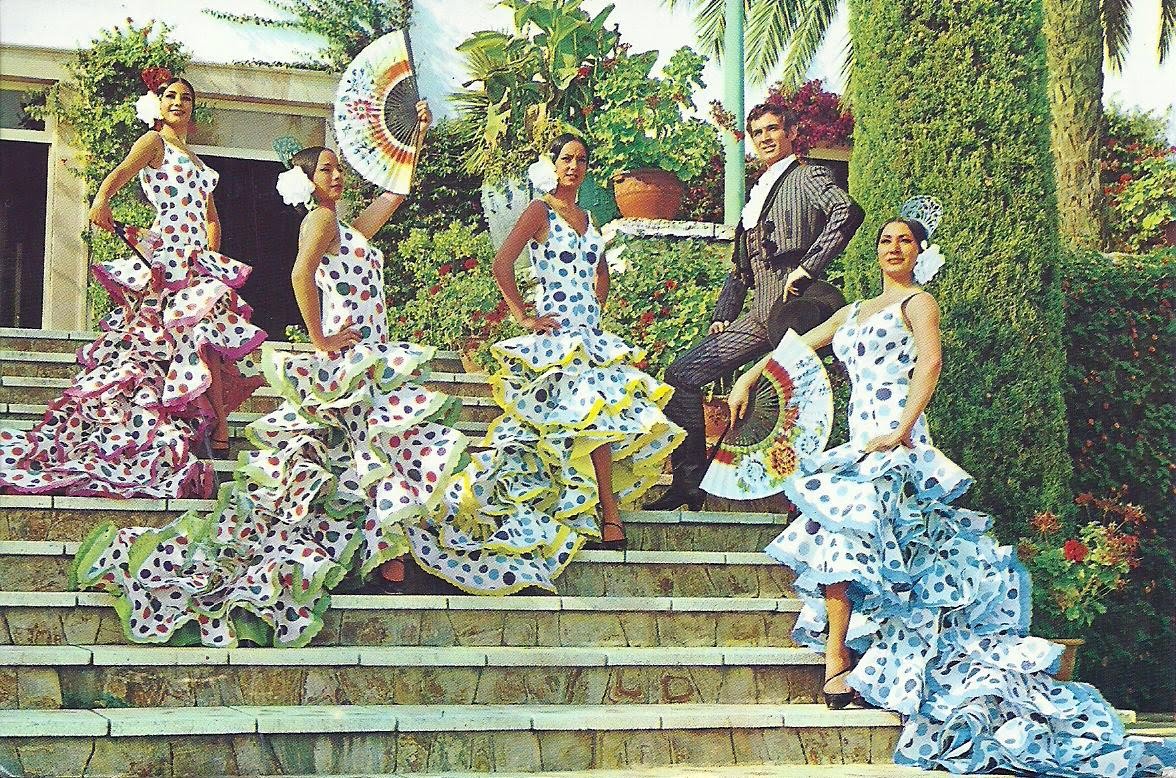
Spain - Flamenco (2)


Typical Andalusian flamenco costumes.

Sent by Anna, a postcrosser from Costa del Sol in Spain.

The roots of the flamenco dress can be traced to Andalusian women who accompanied livestock traders to livestock fairs in Seville. Andalusia is a region in southern Spain where gypsies (flamencos) lived.

Flamenco is their traditional song and dance, and the costume reflects that culture. Since the dance became part of the mainstream in the early 19th century, the dress has evolved, but the Andalusian influence remained.(Read more)


Monday, March 29, 2010

Spain - Flamenco


We sent a postcard to Patricia in Valencia, Spain under the official Postcrossing and in return she sent this black-and-white flamenco postcard.

Flamenco is an artistic expression fusing song (cante), dance(baile) and musicianship (toque). Andalusia in southern Spain is the heartland of Flamenco, although it also has roots in regions such as Murcia and Extremadura. Cante is the vocal expression of flamenco, sung by men and women, preferably seated, with no backing singers. The gamut of feelings and states of mind – grief, joy, tragedy, rejoicing and fear – can be expressed through sincere, expressive lyrics characterized by brevity and simplicity. Flamencobaile is a dance of passion, courtship, expressing a wide range of situations ranging from sadness to joy. The technique is complex, differing depending on whether the performer is male (heavier use of the feet) or female (gentler, more sensual movements). Toque or the art of guitar playing has long surpassed its original role as accompaniment. Other instruments, including castanets, hand-clapping and foot-stamping are also employed. Flamenco is performed during religious festivals, rituals, church ceremonies and at private celebrations. It is the badge of identity of numerous communities and groups, in particular the Gitano (Roma) ethnic community, which has played an essential role in its development. Transmission occurs through dynasties, families, social groups and Flamenco clubs, all of which play a key role in its preservation and dissemination. (Source)