Translate

Thursday, May 23, 2013

Bicycle (37)


Sent by Ria, a postcrosser who lives near Eindhoven, Netherlands.


Bicycle (36)


Sent by Kerry, a postcrosser from Canada.


Wednesday, May 22, 2013

Romania - Churches of Moldavia (2)


ROMANIA
Mănăstirea Humor or Humor Monastery, a part of Churches of Moldavia, a UNESCO World Heritage Site.

Sent by Marius, a postcrosser from Romania.


Monday, May 20, 2013

Uzbekistan - Historic Centre of Bukhara


Abdullah Khan Madrasa

Sent by Marina from Tashkent, Uzbekistan.

Bukhara, which is situated on the Silk Route, is some 25 centuries old. It is the most complete example of a medieval city in Central Asia, with an urban fabric that has remained largely intact. Monuments of particular interest include the famous tomb of Ismail Samani, a masterpiece of 10th-century Muslim architecture, and a large number of 17th-century madrasas. The historic part of the city, which is in effect an open-air museum, combines the city's long history in a single ensemble.

Archaeological excavations have revealed that the settlement on the site of latter-day Bukhara became part of the Kushan state as early as the 2nd millennium BC. In the 4th century it was incorporated into the Ephtalite state. Before the Arab conquest Bukhara was one of the largest cities of central Asia, owing its prosperity to its site on a rich oasis and at the crossroads of ancient trade routes. It became a major cultural centre of the Caliphate of Baghdad in 709, and in 892 the capital of the independent Samanid Kingdom. A time of great economic growth came to an end with the sack of the city in 1220 by the Mongol horde of Genghis Khan. It slowly recovered, to become part of the Timurid Empire. The internal strife of the late 15th century led to the occupation of Bukhara by nomadic Uzbek tribesmen led by Khan Sheibani, becoming the capital of the Bukhara Khanate. A long period of unrest and short-lived dynasties ended in 1920, when it was absorbed into the Soviet Union; nevertheless, this period saw Bukhara consolidating its role as a major commercial and cultural centre.
The townscape of latter-day Bukhara represents every stage of the city's history. The earliest monuments include the 10th century Ismail Samani Tomb, the decorated brick minaret of Poi-Kalyan from the 11th century, along with the Magoki Mosque and the Chasma Ayub Shrine. The Timurid period is represented only by the Ulugbek Medresseh. The most celebrated buildings date from the Shebibanid period - the Poi-Kalyan group, the Lyabi-Khauz ensemble, the Kosh Medresseh, and the Gaukushon Medresseh. A little later came the medressehs at important crossroads, such as Taki Sarafon (Dome of the Moneyshangers, Taki-Tilpak-Furushan (Dome of the Headguard Sellers), Tim-Bazzazan, and Tim-Abdullah-Khan. Among the fine buildings erected in the anarchic early 17th century must be included the great new mosque Magoki Kurns (1637) and the imposing Abdullah-Khan Medresseh. It should be stressed, however, that the real importance of Bukhara lies not in its individual buildings but rather in its overall level of urban planning and architecture, which began with the Sheibanid dynasty. (read more)


Japan - Asakusa Sanja Festival


JAPAN
Akasuka Sanja Festival or Sanja Matsuri, Tokyo.

Sent by Yuki, a postcrosser from Tokyo, Japan.

Sanja Matsuri (三社祭?, literally "Three Shrine Festival"), or Sanja Festival, is one of the three great Shinto festivals in Tokyo. It is considered one of the wildest and largest. The festival is held in honor of Hinokuma Hamanari, Hinokuma Takenari and Hajino Nakatomo, the three men who established and founded Sensō-ji. Sanja Matsuri is held on the third weekend of every May atAsakusa Shrine. Its prominent parades revolve around three mikoshi (three portable shrines referenced in the festival's name), as well as traditional music and dancing. Over the course of three days, the festival attracts 1.5 to 2 million locals and tourists every year. (read further)


Friday, May 17, 2013

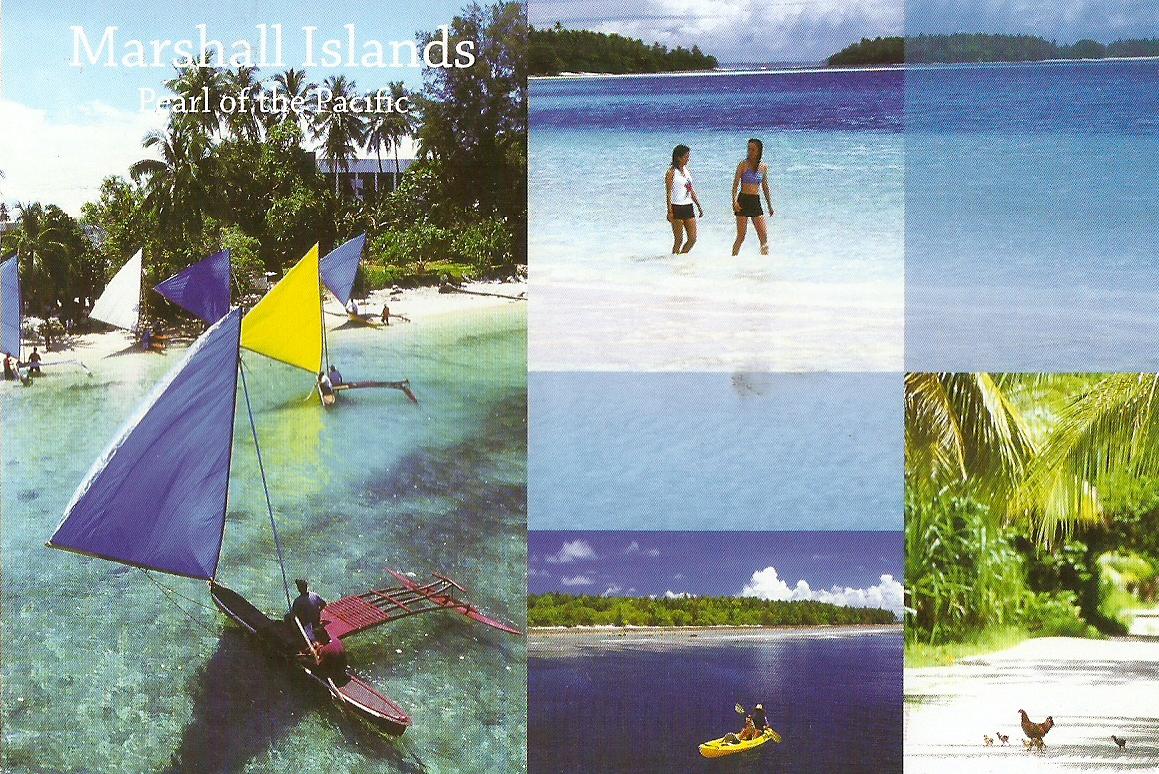
Marshall Islands - Pearl Of The Pacific


Iokwe
We welcome you to come visit the Republic of the Marshall islands in Magnificent Micronesia. Experience beauty and nature in its finest form.

Sent by MIVA. Thank you.


The Marshall Islands, officially the Republic of the Marshall Islands (Marshallese: Aolepān Aorōkin M̧ajeļ), is an island country located in the northern Pacific Ocean. Geographically, the country is part of the larger island group of Micronesia, with the population of 68,480 people spread out over 34 low-lying coral atolls, comprising 1,156 individual islands and islets. The islands sharemaritime boundaries with the Federated States of Micronesia to the west, Wake Island to the north, Kiribati to the south-east, and Nauru to the south. The most populous atoll is Majuro, which also acts as the capital.

Micronesian colonists gradually settled the Marshall Islands during the 2nd millennium BC, with inter-island navigation made possible using traditional stick charts. Islands in the archipelago were first explored by Europeans in the 1520s, with Spanish explorer Alonso de Salazar sighting an atoll in August 1526. Other expeditions by Spanish and English ships followed, with the islands' current name stemming from British explorer John Marshall. Recognised as part of the Spanish East Indies in 1874, the islands were sold toGermany in 1884, and became part of German New Guinea in 1885. The Empire of Japan occupied the Marshall Islands in World War I, which were later joined with other former German territories in 1919 by the League of Nations to form the South Pacific Mandate. InWorld War II, the islands were conquered by the United States in the Gilbert and Marshall Islands campaign. Along with other Pacific Islands, the Marshall Islands were then consolidated into the United-States-governed Trust Territory of the Pacific IslandsSelf-government was achieved in 1979, and full sovereignty in 1986, under a Compact of Free Association with the United States.

Politically, the Marshall Islands is a presidential republic in free association with the United States, with the US providing defense, funding grants, and access to social services. Having few natural resources, the islands' wealth is based on a service economy, as well as some fishing and agriculture, with a large percentage of the islands' gross domestic product coming from United States aid. The country uses the United States dollar as its currency. The majority of citizens of the Marshall Islands are of Marshallese descent, with small numbers of immigrants from the Philippines and other Pacific islands. The two official languages are Marshallese, a member of the Malayo-Polynesian languages, and English. Almost the entire population of the islands practises some religion, with three-quarters of the country either following the United Church of Christ – Congregational in the Marshall Islands (UCCCMI) or theAssemblies of God. (read further)


Croatia - Krk Island


Multiviews of Krk Island.

Sent by Tomislav, a postcrosser from Zagreb, Croatia.

Krk (pronounced [kr̩̂k]; German: Vegl; Latin: Curicta; Italian: Veglia; Vegliot Dalmatian: Vikla; Ancient greek Kyrikon, Κύρικον) is a Croatian island in the northern Adriatic Sea, located near Rijeka in the Bay of Kvarner and part of the Primorje-Gorski Kotar county.

Krk has for many years been thought the largest Adriatic island, with an area of 405.78 km2 (156.67 sq mi), although recent measurements now give the neighbouring island of Cres an equal surface area. Krk is also the most populous island, with numerous towns and villages totalling 19,286 (2011). (read further)


Germany - Schleswig-Holstein - Kiel


Greetings from City of Kiel

Sent by Christina, a postcrosser from Germany.


Germany - Hamburg/Lower Saxony - Altes Land


Greetings from the Altes Land

Sent by Renee, a postcrosser from Stade, Germany.

Altes Land is an area of reclaimed marshland straddling parts of Lower Saxony and Hamburg. The region is situated downstream from Hamburg on the southwestern riverside of the Elbe around the towns of Stade, Buxtehude, Jork and the Samtgemeinde of Lühe. In Hamburg it includes the quarters of Neuenfelde, Cranz, Francop and Finkenwerder.

The region – the biggest contiguous fruit-producing region in Central Europe – extends over 143 km2 (55 sq mi). 76.8% of the trees areapples, 12.7% are cherries. The areas closest to the Elbe are those with the highest population. They include the most fertile marshlands; towards the Geest the area connects to fens.

The fertile land led to the development of a culture dominated by farming. The villages are known as Marschhufendörfer, a special kind of village where the farmyards are set along a street with the land directly behind them. A characteristic feature is the richly-decorated half-timbered farmhouses with their elaborate gateways. (read further)


Thursday, May 16, 2013

Netherlands - Edam Cheese


Edam Cheese Market

Sent by Marissa, a postcrosser from Leiden, Netherlands.

Edam (DutchEdammer) is a semi-hard cheese that originated in the Netherlands, and is named after the town of Edam in the province of North Holland. Edam is traditionally sold in spheres with a pale yellow interior and a coat of red paraffin wax. Edam ages and travels well, and does not spoil; it only hardens. These qualities (among others) made it the world's most popular cheese between the 14th and 18th centuries, both at sea and in remote colonies.

Most "young" Edam cheese sold in stores has a very mild flavor, is slightly salty or nutty, and has almost no smell when compared to other cheeses. As the cheese ages, its flavor sharpens, and it becomes firmer. It has a significantly lower fatcontent than many other traditional cheeses; as little as 28 percent of the cheese is made up of fat. Modern Edam is softer than other cheeses, such as Cheddar, due to its low fat content. However, it is not quite as suitable for toasting as are certain other cheeses, such as Cheddar. (read further)


France - Paris


PARIS AND ITS WONDERS
Place du Tertre and its painters. 
The Basilica of Sacré-Cœur.

Sent by Ecole, a group of postcrossers from France.


USA - New Jersey - State Flower


NEW JERSEY'S STATE FLOWER
Common Meadow Violet
(Viola sororia)

With its official status uncertain for over 50 years, the Violet was designated as the state flower in 1971 with strong support from garden clubs across the state. This plant is in bloom from March to June with purple or violet petals.

Sent by Megan, a postcrosser from Missori, USA.

The state flower of New Jersey was originally designated as such by a resolution of the Legislature in 1913. Unfortunately the force of resolution ended with the start of the 1914 legislative session, leaving the violet with uncertain status for the next fifty years. In 1963 an attempt was made to have the Legislature "officially" designate the violet as the state flower, but the legislation apparently failed. In 1971, at the urging of New Jersey's garden clubs, legislation more specifically designating the Common Meadow Violet (Viola sororia) as the state flower was enacted. (Source)


Bicycle (35)


Sent by Minna, a postcrosser from Leppävirta, Finland.


Netherlands - Doetinchem


Multiviews of Doetichem.

Sent by Kirsty, a Swap-Bot partner from Doetinchem, Netherlands.

Doetinchem (Dutch pronunciation: [ˈdu.tɪn.ˌxɛm]; Low Saxon: Deutekem) is a city and municipality in the east of theNetherlands. It is situated along the Oude IJssel (Old IJssel) river in a part of the province of Gelderland called the Achterhoek . The municipality has 56,275 inhabitants (January 1, 2012) and has an area of 79.67  km² (of which 0.57 km² is water). This makes Doetinchem the largest town (by population) in the Achterhoek.

On 1 January 2005, a municipal reorganization merged the neighbouring municipality of Wehl into Doetinchem. (Source)


Réunion - Heritage Nature


Réunion Island - Heritage Nature

Sent by Wojcik Family from Réunion Island.